Somewhere in the next few weeks, a lot of us are going to make the same phone call.
Budget season lands, the number we have to hit lands with it, and we call our biggest provider. "We've been looking at next year. We need a 20% rate reduction, or we're going to have to put this back out to RFP. What can you do for us?"
I made that call at Google (or was forced to), I made it for my clients, and I also spent a lot of time trying to convince my powers that be whomever they were at the time why it was a bad idea. And I'll tell you the uncomfortable thing I learned: most of the time, the buyer making that call has already decided to accept a worse outcome than the one they could have had. They just don't know it yet, because the number on the invoice is going to go down, and the number going down is the only thing anybody checks.
Here's the other thing I learned sitting in that chair. You can usually tell which providers are going to fold and which ones are going to play financial magic: a new number that looks like a win for you and costs them almost nothing. The ones who played it well were the ones who stayed for a decade.
So here's what actually happens after you make that call, and how to tell a real saving from a good trick.
Your own bonus is the weak point
Every procurement person I know has a savings target in their annual review. If the spreadsheet doesn't show a lower number this year than last year, the bonus doesn't happen.
Providers know this. It is, honestly, the first thing a good account team studies about you. And once they know your target, they don't have to make your company cheaper. They only have to make the line you are measured on cheaper.
Those are not the same thing, and the gap between them is where the money goes.
I've watched a buyer celebrate a double-digit rate reduction where only a fraction of it ever left the business. The rest came back as change orders, out-of-scope tickets, a slower queue that three internal teams quietly staffed around, and a "transformation fee" in year two. The rate card was beautiful. The total was worse.
So before you make the call, do two things.
Write down the number you're actually trying to move. If it's the rate, say so, and know that you're asking for a smaller thing than you think. If it's what this service costs the company, say that instead, because it changes the entire conversation and it's much harder to fake.
Then agree with finance how the saving will be counted. The rate, or the total bill? Adjusted for volume, or not? A lower rate on more volume can still mean a bigger bill, and finance sees the bill. Settle it before the call and nobody can hand you a number that only looks good on your scorecard.
Where a lower price can actually come from
Here's the lens I wish someone had handed me years ago. A provider's cost is mostly people. So when the price goes down, the money can only come from a handful of places:
- Less work. You send them less volume, or take tasks out of scope.
- Different work. You accept a lower service level.
- Fewer hours per unit. They fix the process or automate part of it.
- Cheaper hours. They change who does the work: more junior people, a different location, a different mix.
- Something you give back. A longer term, more volume, faster payment. These are worth real money to a provider, and some of them cost you very little.
- Less margin. They simply make less money on you.
That's the whole list. Every offer you'll get is some mix of those six, and the only useful question is which ones, and how much of each.
The first three change what you buy. The fifth changes what you commit to. The last one is real, but it rarely lasts. The fourth is the one nobody announces. If an offer can't tell you where the money is coming from, assume it's coming out of the service, and most likely out of the fourth.
The four plays you'll hear after you ask
When you make the ask, a good provider runs a play. There are basically four, and you should be able to name which one you're looking at.
1. The panic discount. They say yes, fast, with no conditions. Your instinct will be that you won.
You didn't. A provider delivering a hundred dollars of service on eighty dollars of budget has to find the twenty somewhere, and the usual place is who does the work. Your best people get moved to an account that still pays, and their replacements cost less. You'll feel it in month seven, when the person who knew your process is gone and the new one is asking you questions you answered two years ago. Then you'll spend a year documenting the decline, and you'll fire them, and the transition will cost you more than the discount ever saved.
If a provider folds immediately, that's not a win. That's information: they were charging you too much, or they're about to take it out of the service. Ask which one. Then ask who will be doing your work after the new price starts, and get your key roles, and notice before anyone in them changes, in writing.
In the workbook this one shows up as a straight margin concession, and it's the line most likely to come back with nothing written next to what you gave up.
2. The re-scope. "We can hit your 20%. Today we're answering in one hour against a 99.5% target. If we move to four hours, and push the non-critical tickets to a self-service portal, we can get there."
This one is honest, and it's usually the right answer. If you want to pay less, you have to buy less. It's that simple. But it only works if you know what you just sold. Somebody in your business is relying on that one-hour response, and it probably isn't the person in the room. Find out who before you agree, not after they escalate.
Then write it down properly. The price goes down because the scope or the service level goes down, and the contract says exactly which. Some people call that a structural concession. Without it, you've agreed to a lower price and a vague promise, and the next cut comes out of something you didn't choose.
The test is one sentence long. Can you write down what got worse? If you can't, you didn't re-scope. You just got a discount you haven't been billed for yet.
3. The automation dividend. "We'll invest in automating a chunk of this workflow. You get 15% starting in month six. We keep the rest to pay for the tooling."
This can be a genuinely good deal for both sides, and it's the one I'd push for in most relationships worth keeping. Three things to watch.
First, the split is negotiable and almost nobody negotiates it. If they're proposing to keep half the benefit, ask what happens to your share in year three when the tooling is paid off. Write the answer into the contract, with a date.
Second, agree how you'll know it happened: the starting point, how it's measured, and what happens to your 15% if the automation goes live late or does less than promised.
Third, you're about to become more locked in, not less. The efficiency lives in their tools now. Ask what happens to the automation if you leave: can you buy it, license it, or at least take the documentation? That's a real trade, and it's often worth making, but make it with your eyes open and get your exit terms looked at in the same conversation.
4. The commercial model change. "Let's move off hourly rates and price per invoice, per ticket, per claim."
Unit pricing is usually better for both sides. When you pay by the hour, every hour they save is money they lose, so they have no reason to get faster. When you pay by the unit, they finally do.
Here's the part nobody says out loud. Once you're on unit pricing, every efficiency they find goes to their margin, not your invoice, unless you wrote down otherwise. They can hand you a 5% "efficiency discount" every year while their actual margin climbs. That's not dishonest. It's how the model works, and it's exactly why they want it.
So take the unit price, and take a productivity commitment with it. A stepped rate. A volume band. A benchmark clause. Something that says the curve keeps moving for both of you. If they'll do the model but not the commitment, you've learned what the model was for.
And sometimes they just say no
It feels like a failure. It usually isn't.
A provider who says "we can't do 20% at this scope, here's what we can do at 8%" is telling you something honest about their cost base, and that's more useful than a yes you can't explain. The question to ask isn't "will you," it's "what would have to change for you to."
If the answer is nothing, you've learned that your leverage is smaller than you thought. Much better to learn that now than after you've told your CFO a number.
Is your RFP threat real?
"Or we'll put it back out to RFP" is the stick in almost every one of these calls. Here's the uncomfortable part: a good account team usually has a better idea of what it would cost you to switch than you do.
Before you say it, price it: the RFP itself, the transition, months of a new team learning your process while your own people cover the gaps. If the saving you're asking for wouldn't pay for all of that in a reasonable time, the threat is empty, and they'll have done that math before you hang up.
That doesn't mean you have no leverage. It means your leverage is information, not threats: a benchmark, a real market check, a clear picture of what the work should cost. Only use the threat if you'd actually follow through.
Never accept a number without the bridge
This is the single most useful habit in this whole article, and it takes one sentence in an email.
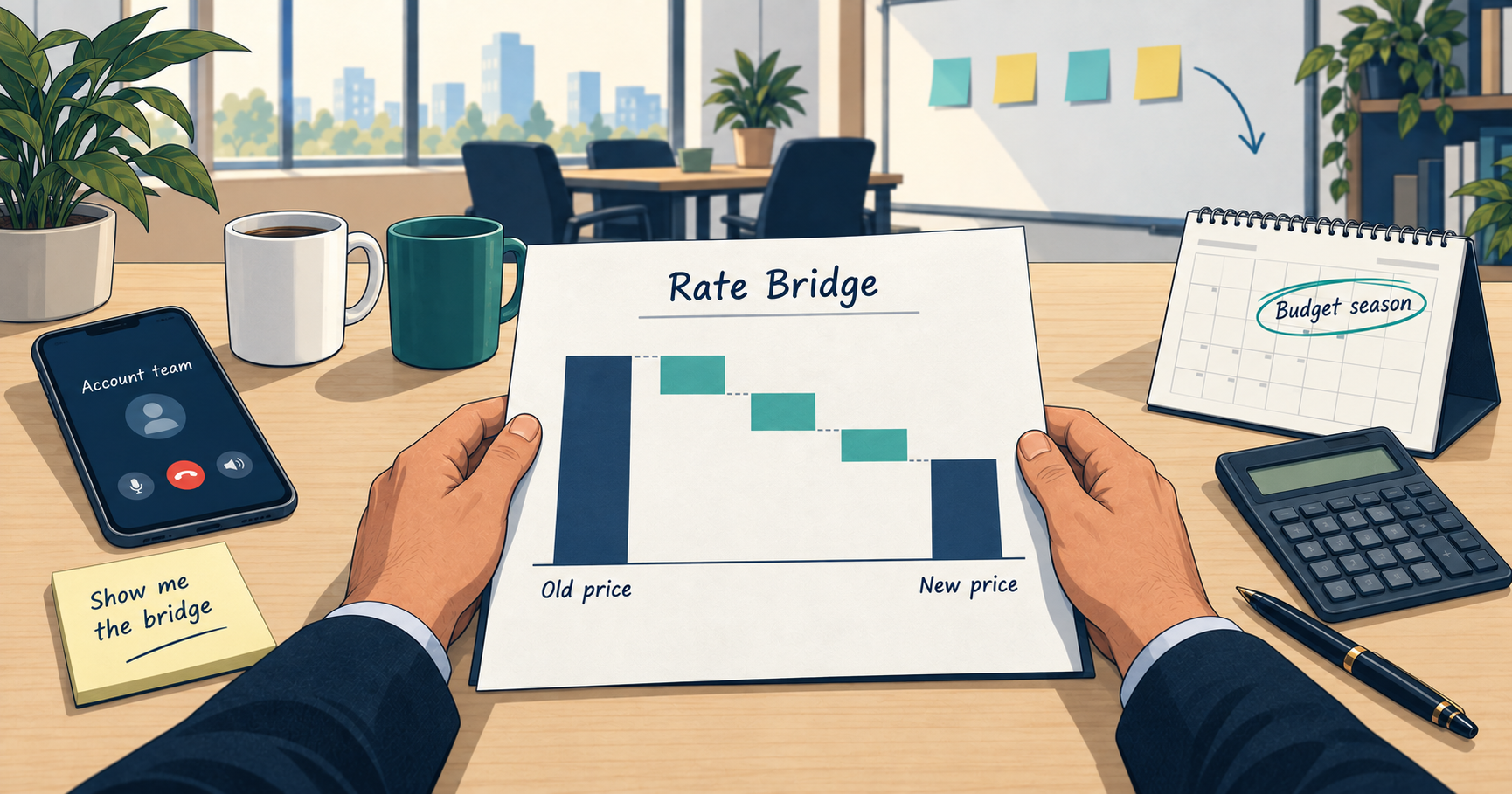
When a provider comes back with the lower number, ask them to show you the bridge from the old number to the new one. Every line: how much came from removing volume, how much from the service level change, how much from automation, how much from a change in who does the work, how much from their own margin.
Two things happen when you ask.
If they can show it, you now have something rare: a shared, itemized model of what this service costs and what you gave up to make it cheaper. Six months later, when someone asks why the queue got slower, you have the answer in writing instead of an argument.
If they can't show it, that tells you something too. A number that arrives without a bridge came from one of two places. Either they were overcharging you and just gave some of it back, which is worth knowing, or they haven't worked out yet where it's coming from, which means it's coming out of the service and neither of you has decided which part.
The bridge is also how you stop your own organization from misreading the deal. "We got 20%" travels. "We got 20%, of which twelve points is a service level we agreed to lower and four is volume we stopped sending" is what your successor needs when they inherit this contract and wonder why the SLA looks like that.
And don't file it away. Ninety days after the new price starts, walk the bridge again, line by line. Did the volume actually come out? Did the automation go live? Is the service where you agreed it would be? A saving that only exists in the proposal is still just a good trick.
Rate normalization, or why the cheapest rate isn't
One more trap, because it shows up every time a rate reduction turns into a competitive threat.
You go out to market, a new provider quotes a rate that's 30% under your incumbent, and it looks like your incumbent has been taking you for a ride. Sometimes that's true. Usually it isn't.
Rates are quoted on different things. One includes the team lead, the other bills them separately. One includes the tooling, the other has a platform fee on page 14. One assumes your people do the quality checks. One has travel, one doesn't. One is a blended rate across a pyramid you haven't seen.
Before you compare anything, normalize. Add back everything one quote includes and the other charges for, then divide by the work, not by the hour. Cost per invoice processed. Cost per ticket closed. Cost per claim. The unit is what you actually buy.
I've seen a rate gap that looked enormous collapse to almost nothing once it was normalized, and I've seen one turn out to be completely real. Either answer is useful. The unnormalized comparison is worse than useless, because it's the one you'll quote to your executive committee and then have to walk back.
What I'd actually do
If you're heading into this conversation, here's the short version.
Know your baseline in units, not rates, before you call. If you can't say what a ticket costs you today, you can't tell whether anything you're offered is good.
Decide in advance what you're willing to give up. Response times, scope, flexibility, a longer term, more volume, faster payment. All of these are worth real money to a provider, and several of them cost you very little. A rate reduction you pay for with a two-year extension is usually a better trade than one you pay for with a service level that three teams depend on.
Ask for the total, not the rate. "Reduce what this service costs us by 20% and show me the bridge" is a much harder thing to fake than "give me 20% off the rate card."
Read your annual increase clause before you celebrate. If the price goes up 4% a year, a 10% cut puts your bill back near today's number by year three. The saving is still real against what you'd have paid, but your budget won't look that way, and finance will notice. Negotiate the increase in the same conversation. A cap, or a year with no increase, is often easier to get than more off the rate.
And be honest about the relationship you want. If you're going to run this provider for five more years, squeezing them to the bone in year three is a decision to have a worse service in year four. If you're planning to replace them, say that to yourself out loud, and run a real market process instead of using the threat of one to extract a discount you'll pay for later.
The number on the invoice is the easiest thing in this whole business to move. It's also the easiest thing to move without changing anything real.
Take the Buyer Negotiation Blueprint into your next provider call
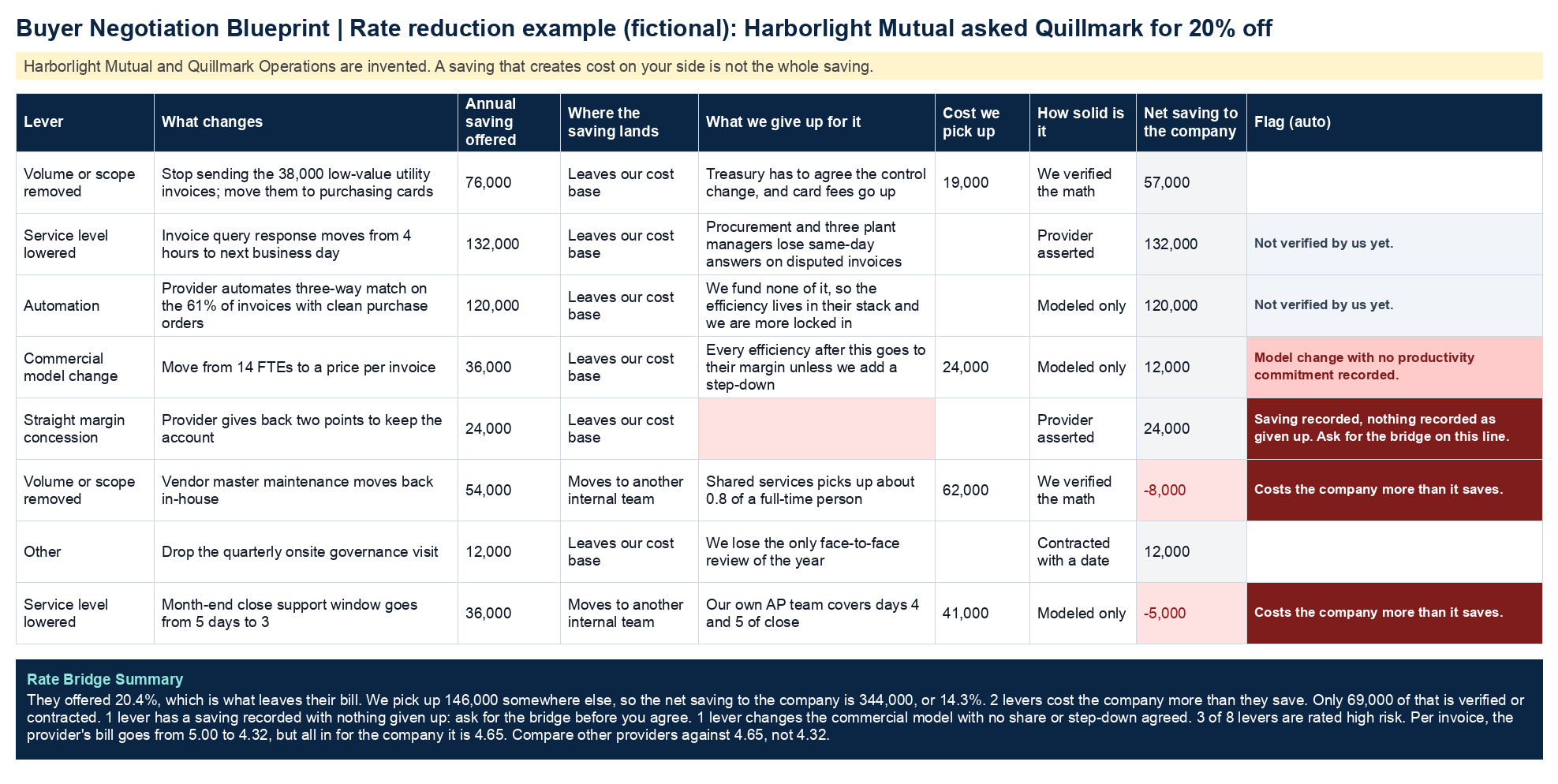
The Buyer Negotiation Blueprint from our contract issue now has a rate reduction section for exactly this conversation. Start with the filled fictional example, then use it for your own contract.
You work each lever separately, and the Rate Bridge builds the bridge line by line. Then it does two things most savings spreadsheets skip. It has a column called "cost we pick up," because almost every real saving creates some cost on your side: card fees when invoices move off the service, your own people covering the days you gave back, a system change. In the filled example, two of the eight levers come out negative. They cost more than they save. That's the most common thing I see in a real bridge, and almost nobody counts it. It also gives you two cost-per-unit numbers: what the provider's bill works out to ($4.32 an invoice in the example, down from $5.00) and what it costs your company all in ($4.65). Hold other providers to the second one, or you're asking them to beat a price you aren't actually paying.
The Blueprint tab now has rate reduction starter items too, so the bridge, the automation split, the productivity commitment and the protected service levels sit in the same plan as everything else. And the prompts page does the heavy lifting with whatever AI your company already approved.
One caution: your target, your walk-away and your leverage notes are for your side only. If you walk the provider through the model, use a copy without them.
Buyer Negotiation Blueprint and Rate Reduction AI Kit
One Excel workbook for the whole negotiation, now with a rate reduction section: a Rate Bridge, a live Rate Bridge Summary, a filled fictional example and a Run it with AI tab, alongside the Blueprint, Negotiation Summary and contract example from our contract article. Plus thirteen tested prompts that get Microsoft 365 Copilot, ChatGPT or Gemini to build your baseline, find out who actually uses the service levels you are about to trade away, take the provider's proposal apart lever by lever, and check a quarter later whether the saving actually showed up. Open the Start here tab first.
Free download. No sign-in required. The example companies, people and numbers are invented. This is a planning tool, not legal, tax or accounting advice, and it doesn't decide what you should sign. Keep your working copy inside your company's approved systems.