You've picked a provider. The RFP is finally over. Your evaluation team can stop arguing about scores, procurement can point to the savings, and somebody has already put the new price into next year's budget.
Hold your horses, cowboy.
You still have to turn that beautiful proposal into a service your business can actually use. That's the buyer's job in contract negotiation, and it takes more than getting another two percent off the rate card.
The lofty promises now meet the cold, hard, sometimes painfully detailed reality of the agreement. Somewhere in those redlines, you need to answer a practical question: when the work gets difficult, what exactly have we bought?
As buyers, we should want a fair deal that works for our business. The contract is our pre-nup, marriage vows and shared household budget rolled into one. A spectacular discount won't feel like much of a victory if our team spends the next three years compensating for everything we forgot to agree.
It's easy for us to become what I like to call "rate card warriors," treating another discount as the only measure of a good negotiation. The rest of the agreement deserves just as much attention.
Decide what matters before you start trading
Before the negotiation, sit down with the people who will depend on the service. What do they need the provider to do? What would be useful but optional? What could they live without? And what would make the deal unacceptable?
Those are different positions. Write them down separately.
If an operations lead needs a reliable exception report, don't translate that into a vague demand for "best-in-class reporting." Describe the information, when it's needed and the decision it supports. You can then negotiate how to get it without losing sight of why it matters.
Agree internally who can approve a trade. Procurement cannot casually give away a service level that operations needs, any more than operations should promise a volume commitment that finance has never seen.
Keep your minimum acceptable positions and walk-away points inside your own team. The supplier needs to understand your requirements. It does not need a copy of your entire negotiation strategy.
Buy a way to resolve problems, not a calendar of meetings
Governance can sound like the boring bit. Weekly operations meeting. Monthly review. Quarterly executive steering committee. Lovely. Who can actually fix anything?
If you're worried about losing control when you outsource, negotiate how you will exercise it. Name the roles that can make decisions, the issues they can resolve and the escalation path when they can't.
Take a plausible problem into the discussion. Suppose the backlog is growing and the two service leads disagree about why. What information will you receive? Who can authorize a response? How will you know whether the action worked?
Include problems on your side too. If your security team or business unit is blocking the service, you need that raised with someone who can act. Otherwise, your own internal mess becomes a recurring explanation for disappointing performance.
You are buying a workable way to run the relationship. A meeting invitation doesn't deliver that.
Ask to see the report you will actually receive
"Comprehensive reporting" sounds reassuring until you discover that your team has to rebuild it every month before anyone can use it.
Ask for a sample before you sign. Can you see the volume arriving, the work completed, the backlog, the exceptions and the action being taken? Does it explain the trend, or just decorate the page with green boxes?
Imagine forwarding it to your boss. What would you still have to chase or explain?
Agree the useful content, frequency, format and responsible role. Be clear about what reporting is included and what would be separately scoped. You don't need every possible metric. You need the information that helps you run the service and explain it to your own organization.
Turn the innovation promise into something you can check
Every supplier has an innovation slide. You should be able to find the corresponding commitment without searching through the sales deck.
Ask what will improve, how the starting point will be measured, who funds the work and when your business receives the benefit. If the proposal includes a productivity reduction, understand the delivery plan behind it and how it reaches your price or service.
Then ask what happens if the improvement is late, smaller than expected or never arrives. Have the relevant commercial and legal specialists put the agreed treatment into the right part of the contract.
Don't count an aspiration as a saving. And don't demand an arbitrary annual percentage just because another supplier once agreed to it. Your goal is a credible improvement commitment, not a number that survives negotiation and falls apart in delivery.
Read the SLA with the exclusions beside it
A service-level target can look impressive while measuring something much narrower than the service your users experience.
Suppose you buy one-working-day processing. The clock starts only when the supplier receives a complete request, and your team sometimes submits incomplete ones. What happens during the missing-information period? Who tells the requester what is needed? Does anyone report the total elapsed time?
If you only look at the supplier's processing clock, you can get the Watermelon Effect: green on the outside, red on the inside. Every reported target is met and the service still sucks.
Walk through the definition, exclusions and client dependencies together. Agree what evidence will show each kind of delay, who owns the fix and what your business will see in the report. Accept responsibility for your inputs without allowing the user experience to disappear from view.
Also ask what a tighter target would cost to deliver. Buy the level of service your business needs, with an explanation of how it will be staffed and measured. Don't pay for a demanding number nobody can connect to a real need.
Negotiate the exit while you still like each other
Before you sign, ask how you would move the service if you eventually needed to leave.
What data and documentation would you receive? Who keeps the operating procedures current? What transition assistance is included, what costs extra, and what are you not entitled to take with you?
Get specific enough to judge whether the next team could use the material. A folder full of outdated documents is not much of an exit plan.
Have your specialists settle the actual rights and obligations. Your job as the buyer is to make sure the operational need is understood before the relationship becomes difficult. You don't want your future choices to depend on a handover nobody discussed at signing.
Check what the price assumes
You can pay for time, a defined scope, units of work or an outcome. Each arrangement can leave you carrying costs or risks that aren't obvious from the headline price.
With unit pricing, define the unit, rework, work mix and volume commitments. With a fixed price, understand the scope and treatment of change. With outcome pricing, agree how the outcome is measured and which dependencies you control. Compare alternatives using the same demand assumptions.
Then check whether the delivery plan supports the number. Which roles will be assigned? What management and technology are included? What changes if the volume is different?
You don't need to become the supplier's margin protection department. You do need to recognize when the proposed price depends on removing the people or capabilities you thought you were buying. An enthusiastic "yes" is not evidence that the service can be delivered.
Finish the negotiation in the agreement
If you give something, be clear about what you get. More volume certainty might support a price concession. A simpler reporting requirement might free up effort for something you value more. Neither is automatically a good trade. Check the business effect and get the right internal approval.
Keep the agreed package together. What did you ask for? What did the supplier accept? What did you concede? Where is the final commitment recorded?
That last question matters. A reassuring conversation with the sales team is not the same thing as a commitment your service manager can find and use after go-live.
The test before signature is straightforward: can the people who will run your side explain what they're buying, what they must contribute and which important points are still unresolved?
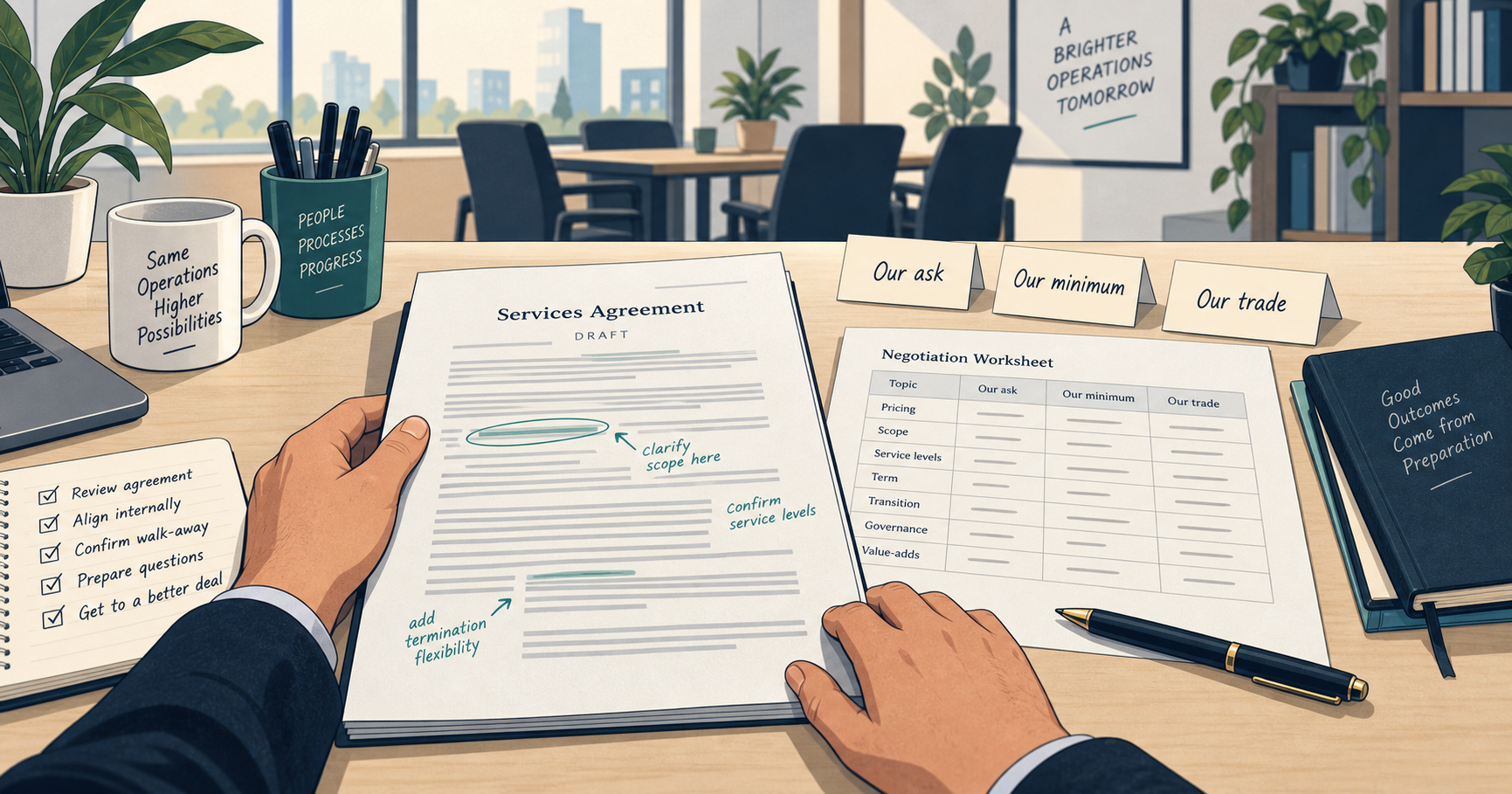
Take a Buyer Negotiation Blueprint into your next session
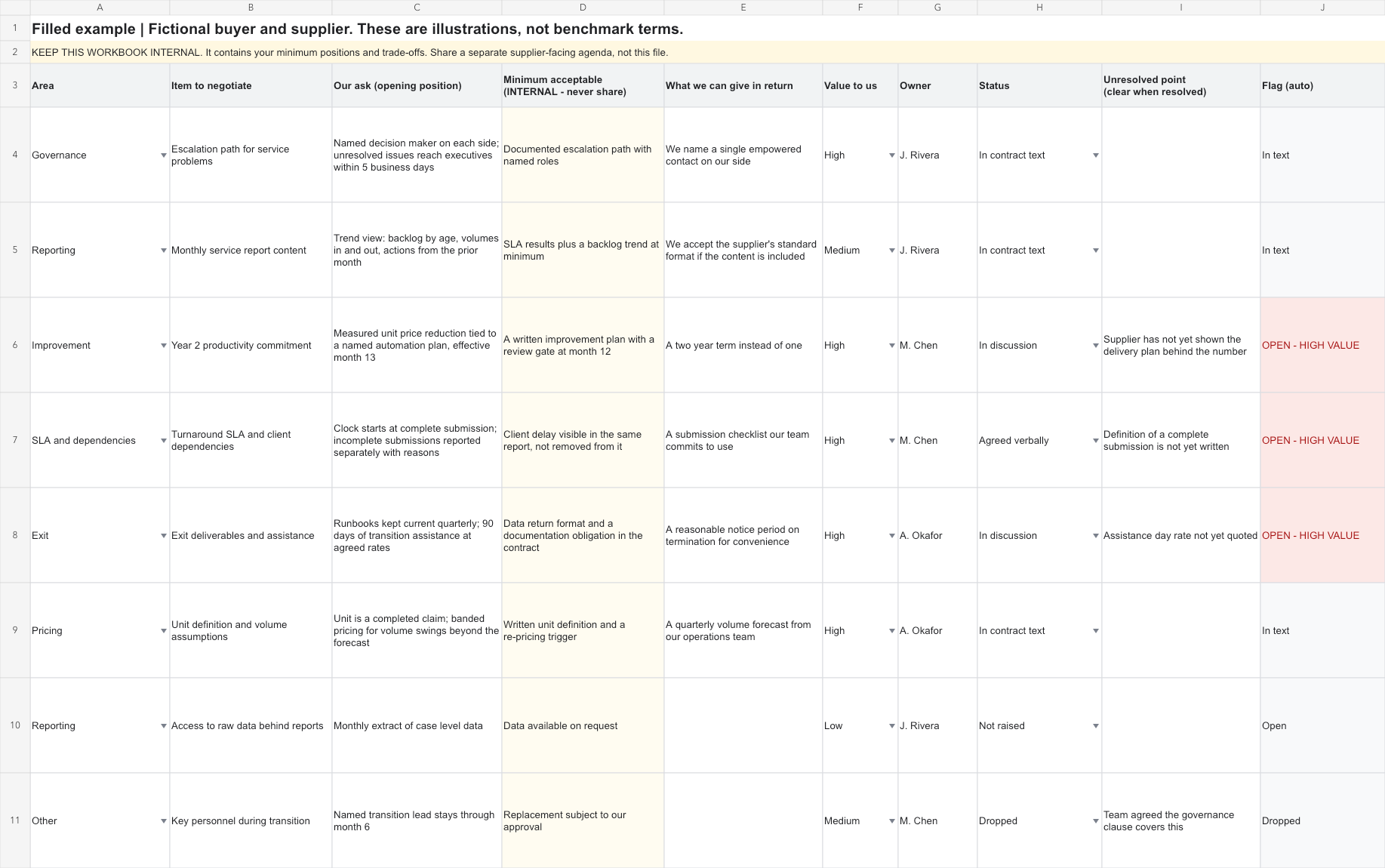
The companion workbook turns those questions into a working negotiation plan. Start with the filled fictional example, then complete your own Blueprint. It has six starter areas from this article and room for 30 items.
For each item, write your opening ask, your private minimum, what you could give in return, its value to your business and the internal owner. Use the status dropdown to distinguish a discussion, a verbal agreement and a commitment your team has actually located in the contract draft.
Keep unresolved questions in their own column. The workbook flags high-value open items and summarizes where the negotiation stands. An item with an unresolved point stays open even if somebody marks it "In contract text." It does not decide whether the contract is legally adequate or ready to sign.
Use those flags to prepare your next conversation. What do we need? What can we trade? What still needs an answer?
One important detail: keep the working workbook inside your team. It contains your minimum positions. Copy the supplier-facing asks into a separate agenda; don't share the file or assume that hiding a column protects it.
Buyer Negotiation Blueprint
One Excel workbook with a working template, automatic negotiation summary and filled fictional example. Download it, open the example first, then start your own Blueprint.
Free download. No sign-in required. The example names and terms are invented, not benchmarks. Once you fill in your own positions, keep the entire working file internal. This is a preparation tool, not legal advice or approval to sign.