I’ve led over 100 outsourced-services RFPs worth $10M+ in annual spend (many of them $100M+), either directly as a buyer-side procurement lead at Google or as a consultant representing a buyer, and there is only one thing that has made every single selection priority list. If you guessed pricing (or ideally total savings delivered for each vendor proposal vs. current state costs), give yourself a gold star! But even the most ruthless priority lists have more than just pricing on them…
The client criteria list
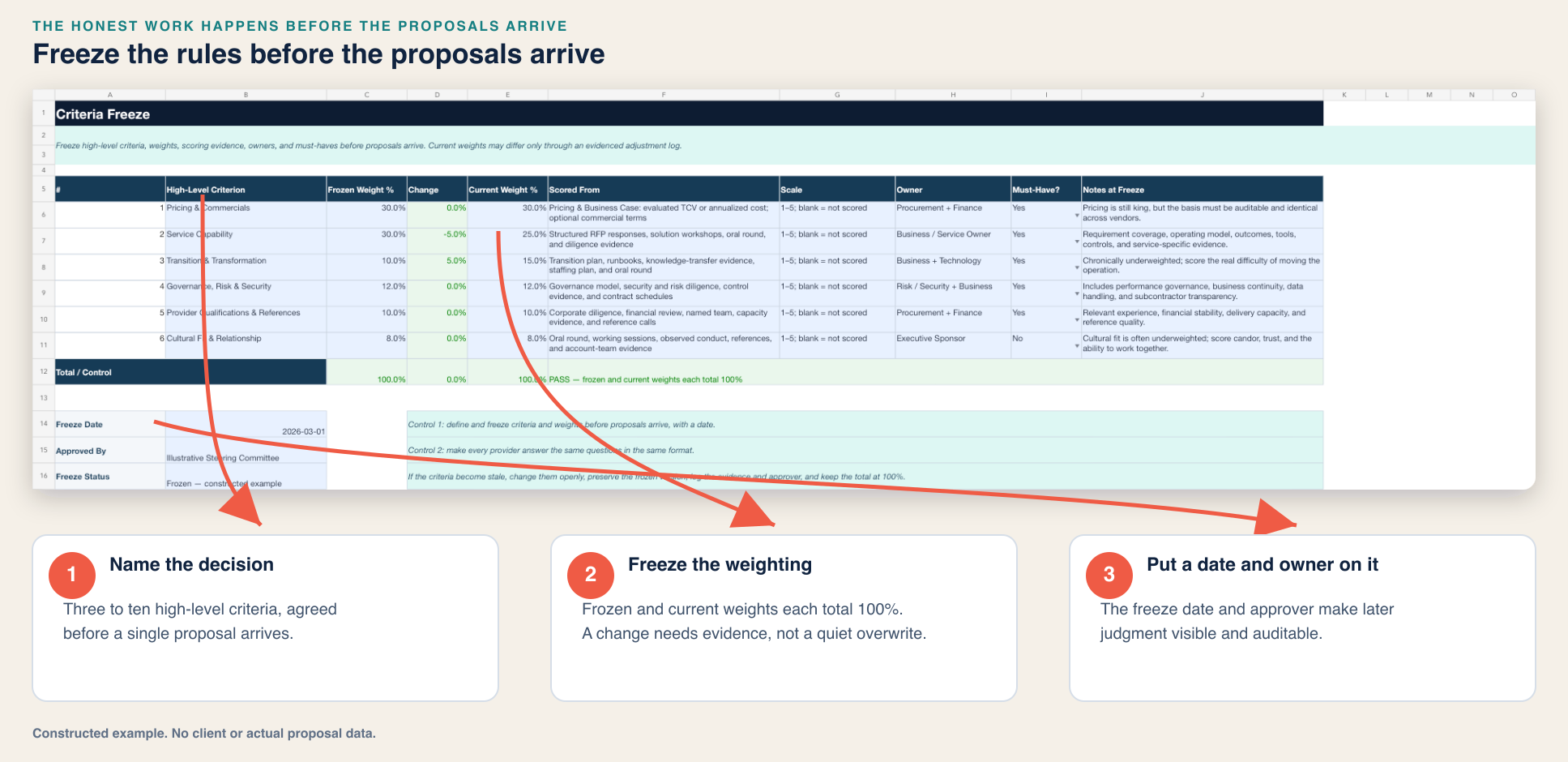
The “client criteria list” is a list of three to ten documented “must-haves” the client executive team has agreed on before putting the operation (and sometimes their careers) in a provider’s hands. It’s a part of every well-managed outsourcing transaction. In a very well-managed RFP, the buyer or their advisor states these directly at the beginning in the RFP Documentation Packet (often called “Selection Criteria”). When the BAFO pricing has come in and the recommendation goes to the executives for approval, each “Criteria” is weighted and rolled up to a single numerical “Proposal Score” for each vendor (e.g. out of 10).
I’m not going to quote a direct number here, but in the vast majority of the RFPs that I’ve managed, the vendor’s proposal with the highest numerical “Proposal Score” was awarded the business…but I’ll share an industry secret: in most cases we “made” the vendor our executive handlers ultimately wanted to hire have the highest score. Before you condemn me to hell, let me explain how the scoring process works and why it’s sometimes more of an art than the science it’s supposed to be.
The RFP Scorecard, Criteria Freeze & Adjustment Log
Download the clean master for your own RFP, or open the populated application-maintenance exercise to see the full logic with five vendors and four evaluators.
The worked example uses real public vendor names as placeholders. Every proposal response, price, and score is fictional and is not an assessment of those vendors.
This RFP “Proposal Score” methodology is a brilliant procurement tool every smart services buyer uses to help synthesize what can be an extremely complex and, in some cases, apples-to-oranges proposal comparison and evaluation process into a single number. The detail and structure of this standard practice ensure that corporate-approved goals are achieved and unacceptable risks are avoided.
Simple re-bid RFPs with a single transactional and mature workflow might only have two or three Criteria: cost savings, service capability, and cultural fit (an often overlooked buyer criterion). Huge multi-tower IT service management RFPs could have ten high-level Criteria with hundreds of individual scoring questions, including must-haves from each and every executive-level stakeholder: the VP of Data Center Operations, the Chief Application Development and Maintenance Officer, Procurement, the CEO’s personal consulting army, the list goes on and on…
Before the scoring starts: down-selection and the RFI
As a note—before we get to detailed scoring, we usually run a “down-selection” phase of the RFP or, in some cases, a full “RFI” (Request for Information) that precedes the RFP. RFPs generally start with a “lite” request for high-level information (often including directional rates) that produces enough “no-gos” to eliminate half the field. Before I make any recommendation to a client or executive team, I’ll put a high-level overview list of 10–15 providers together to show my work. I’ll quickly point out the dealbreakers (e.g. no existing service experience, no offshore locations, very bad PR or prior personal experience, etc.) to make our down-selection decision easier. It also gives the buyer team a flavor of how to identify red flags and differentiators by simply reading proposals (a skill I’ve painstakingly honed after sitting through thousands of supplier solution presentations).
Smart buyers cast a wide net at the beginning of the process to ensure they aren’t overlooking a hot new provider that didn’t exist the last time around, which in the case of SaaS or gig or AI service providers is about every six months. However, the detailed proposal evaluation and project management required to pick one partner is way too expensive and time-consuming to do for more than four to six finalists. But we’ll cover that later…
How the scoring actually works
Every Criteria has one or more “Criteria Questions.” Criteria like “Pricing” or “Physical Security Risk” are scored based directly on each proposal’s hopefully straightforward “total solution cost” and “security assessment score.” More comprehensive Criteria like technology solution or service capabilities can have hundreds of Questions that each RFP team member (or “Scorer”), who has reviewed the proposals, scores out of 10 (or 5, or 67 if you’re getting really weird with it).
This rolls up to an average score for each Criteria, which are weighted out of 100% to represent its relative importance to the business objectives—e.g. Pricing is almost always weighted a minimum of 25%. I’ve even had a few clients/projects where I agreed to bump this up past 50%, but in most cases this defeats the objectives of the evaluation process (if you want to hire the cheapest vendor no matter how terrible they are, then don’t waste anyone’s time pretending it matters).
Questions that a Scorer can’t answer are null, but generally all scores (including executives, if they choose to participate) are treated equally. The assumption is that perspectives from all aspects of the proposed solution, from the day-to-day operations manager to the executive whose neck is on the line, are represented. Generally the lowly operations people’s scores are most important. In most cases the executives don’t really know what’s going on, and getting them to fill out a 300-question survey is not an enviable task, especially if you are a consultant they already loathe being forced upon them by a more powerful executive. The weighted average score of all the Criteria categories equals the total “Proposal Score” for each vendor.
There are a few critical insights related to this scoring exercise to keep in mind as you go through an RFP if you want the score to reflect the best buyer decision—not merely the cleanest spreadsheet.
Getting your stakeholders to actually score
As a procurement/sourcing project leader, the thing that you need your business stakeholders participating in this RFP for THE MOST is this scoring exercise, specifically the “service details” like the provider’s approach to storage re-hydration that you have absolutely no idea what that even means. Unfortunately, the part of the RFP process these people hate most is this scoring exercise.
I’ve sat on the other side of it as an “SME” rather than the sourcing expert on RFP deals plenty of times. Most of the time, we receive a spreadsheet with 25+ Criteria Questions we have to enter a score for. We are emailed five to ten completely different-formatted 50-page Proposal Decks in which we are supposed to find the answer to 25 different questions.
The way that good RFP managers make this easier is by asking vendors to respond to key questions (often aptly called “RFP Questions”) in a spreadsheet that contains the answers to the bulk of the Criteria Questions. We then paste the answers from each vendor into a column so the Scorers can evaluate each proposal response side-by-side. Criteria like “Services Capability” are harder to evaluate this way, and this detail is often sussed out live during RFP Oral Presentations.
RFP Orals are where deals are won and lost
RFP Orals (where providers present their solution live to your team and advisors) are where deals are won and lost. Pricing is still king, but if your team doesn’t like the way a provider talks to them—or the provider fumbles answers to direct questions—that should show up in the score very quickly. In a lot of cases, especially virtual RFP presentations, buyer teams are scoring live.
Listen for the questions from your own team, especially the RFP Lead/Facilitator, because they probably map directly to the scoring model. Write down every direct question your team asks and, immediately after the presentation, sit down together and decide whether the answer was complete or needs written clarification from the provider. Suppose you ask how many times they have set up an MPLS line in Ghana and they say “never.” Give them the chance to find the closest comparable experience and explain how similar and successful it was.
Not even the slickest salesperson in the world is perfect, and I can promise that if a provider tries to bullshit a smart buyer, they will eliminate themselves faster than the most expensive proposal ever seen could. But a revised answer might prompt one judicious Scorer to change a score on one question from a 1 to a 3. Is that going to bump the Proposal Score over the top? Probably not, but literally every point matters—even the ones that really don’t, like Payroll Management experience in a mainframe service management RFP. Sometimes buyer teams have these little “must-haves” that even the best advisor can’t convince them are irrelevant.
How we “made” a vendor have the highest score
When I said before that the vendor with the highest “Proposal Score” almost always wins, I was as serious as a heart attack. The only exception is if a dealbreaker came up during final negotiations that we missed. But with sometimes hundreds of Criteria Questions and apples-to-oranges proposals to evaluate, it’s often difficult to get the numbers to “say” what you think they should. And like I’ll explain below, there are some critical reasons why the client RFP team needs it to be so that vendors, and sometimes the client team members themselves, are not privy to. When I said that we “made” the vendor we wanted to win have the highest score, this is how it works:
Sometimes there was no scoring “finessing” required; the score showed the clear winner based on the RFP Criteria. Sometimes the Criteria we set at the beginning of the RFP needed to be legitimately adjusted: our due diligence eliminated some perceived risk that needed to be down-weighted, or business objectives had shifted in the months since we started the process. Sometimes after our regroup sessions it became clear that one or more of the Scorers were not paying attention, and their scores were just “wrong” and needed to be adjusted after a more detailed evaluation.
And sometimes some generous adjustments to subjective Criteria like “service capability” or “client references” needed to be applied because the numbers just weren’t saying what we thought they should.
You don’t have an intimate knowledge of my character, so you’re just going to have to take my word for it: I never endorsed a proposal that I didn’t think was the best option for my client or for Google (often to my own detriment). If I ever “fluffed” the scoring numbers, it was because we did a bad job of setting the right Criteria and associated Questions up front and it was too late to go back and change them.
Why Proposal Scores really exist
But something critical to keep in mind: the (unspoken) most important reason Proposal Scores exist is a CYA (cover your ass) or get-out-of-jail-free card for the selection team in the very likely event that the operation goes sideways. There are a million things that can go wrong over the course of a five-year contract, and picking the wrong provider or a bad solution is one of them, but the people who are “responsible” for choosing the right partner are usually not the ones who stick around and make sure it’s successful.
So my last piece of advice here—if you are the “RFP Lead,” or simply the person asking the most questions, you can influence both the detailed scoring and the after-dinner-drinks conversations that end up deciding who wins and loses more than anyone else. The person who knows the most about the procurement and outsourcing process is the buyer-side “SME” for this stage of the game (as opposed to the vendor management or business SME who will need to make the relationship work after the award).
This is the person who needs to make sure the whole team—not just the preferred provider—can explain why the winner is the right choice, and the person best positioned to call bluffs before they become contract problems. Show your peers you have done this before by running a process that gives Scorers, executives, and providers what they need before they have to ask for it.
One practical extension for buyers
Keep the Criteria, weights, evidence, scoring changes, and final award rationale together in one traceable record. Whether that record lives in a spreadsheet or a more structured procurement system, the tool should not make the decision for the team; it should make the team’s decision easier to explain and harder to rewrite after the fact.
That traceability is one narrow problem Maxx is being designed to support. It is not a substitute for the RFP Lead’s judgment, the team’s diligence, or a well-run sourcing process.
Use the clean master—or inspect the worked example first
Both versions are downloadable Excel workbooks with no macros. If you run the mock scoring exercise and want a second opinion on your Criteria, reply and I’ll take a look.
The worked example uses real public vendor names as placeholders. Every proposal response, price, and score is fictional and is not an assessment of those vendors.